Showing posts with label carleton. Show all posts

Monday, July 23, 2018

Eisner Awards

The Eisner Awards were announced over the weekend, and it's exciting to hear that Marjorie Liu is the first woman to win an Eisner for Best Writer. It's also just a little bit sad because these awards have been around for thirty years now, but mostly it's exciting.
What's also exciting is that I was reading Monstress BEFORE it won 5 Eisners, so I get to feel smug and self-righteous about my reading habits. It's one of the few comics that I acquire in an issue-by-issue format, rather than waiting for a trade paperback. It's one of my favorites because the art is always gorgeous, cats are heavily featured, the plot is complex and compelling, and it's really refreshing to have so many female characters so strongly foregrounded in the story.
Other cool comics news in my life: Fun Home is on my colloquium reading list for this winter. Therefore, there is no need for me to mount a crusade to add a graphic novel to the list. Hamilton is also on there; the list actually manages to be pretty multimedia. The theme this year is transgression, and I'm actually looking forward to it.

Sunday, September 10, 2017

Back to School

I've enjoyed my trimester in Ireland. I climbed to the top of a round tower in Kilkenny (too tall, 8/10, would not climb again), saw 23 performances, and met 8 published authors. Overall, I'm really glad I did it, although I am currently bemoaning the fact that I still won't get a real break from school work until Thanksgiving.
The two weeks break between my summer and fall trimester has given me time to do a lot of reading that is not remotely related to class or Ireland. I enjoyed Chemistry by Weike Wang, Do Not Become Alarmed by Maile Meloy, and Mrs. Fletcher by Tom Perrotta. I also reread one of my favorite webcomics, Megan Lavey-Heaton and Isabelle Melançon's Namesake, from the beginning again. If you enjoy cute fantasy webcomics, Namesake is certainly one to check out. It includes plentiful references to Baum's Oz books, Carroll's Alice in Wonderland and Through the Looking Glass, as well as mentioning other childhood stories like Peter Pan, "Rumpelstiltskin", and "Jack the Giant-Killer".
I devoured Jeff VanderMeer's compelling and bizarre Southern Reach trilogy: Annihilation, Authority, and Acceptance. I had some difficulty figuring out what genre the books ought to be. Annihilation won a Nebula Award in 2015 for Best Novel, and the Nebula Award is often referred to as a science fiction award, but it is voted on by the Science Fiction and Fantasy Writers of America and given to works of both the science fiction and fantasy genres. Science fiction is probably the best genre to place the Southern Reach trilogy in as a whole, but I'm still not entirely satisfied with that categorization. Annihilation is told from the perspective of the biologist on a four woman expedition to explore Area X. At first, it reminded me of Arthur C. Clarke's Rama series and John Varley's Gaia books, but it quickly became more of a horror story, and the unreliability of the narrator only added to the confusion. With so many unanswered questions, I immediately had to go on to the second book, Authority, which is narrated by John Rodriguez. This book is set in the Southern Reach agency that has been sending the expeditions into Area X and reads a bit like a mystery novel. This was my favorite book in the trilogy and contains a creepy scene that horrified me more than anything in the first book. The conclusion of the trilogy, Acceptance, is written from the viewpoint of various characters at different times and ties the entire trilogy together cohesively.
The 2016 Nebula Awards Best Novel, Naomi Novik's Uprooted, was also an entertaining read. In the first chapter, I was very concerned that the story was going to be a bit formulaic and bland, but those fears were soon laid to rest. As the tension built, later in the book, I became afraid that it would end in the middle of some dramatic event, only for me to learn that it was the first book in a series. Luckily, it's a standalone novel, her first in this particular fantasy universe, and you get all of the exciting action in the one book.
After reading Uprooted, I decided to reread Novik's Temeraire books, beginning with His Majesty's Dragon. I'm currently in the middle of the sixth book, Tongues of Serpents. My thoughts while reading this series are mostly something along the lines of "Where can I find the TV show?". This series would make a fantastic TV show--it's set in a steampunk alternate version of the Napoleonic Wars with dragons. This ought to appeal to the same audiences as Game of Thrones. It's during a war, so there's even some amount of character death and gore, although not quite on the same level as GoT; this show could be a lot more fun. There's politics, dragons, action scenes, dragons, ethics, dragons, and a protagonist who has a lot to learn. I'm waiting.

Thursday, August 10, 2017

Expectations and Observations


Expectations I

Home is the place I can predict.
Away is the place I cannot.

To learn what home is, I leave.
I remind myself:
There are going to be surprises,
unexpected changes,
last-minute reshuffling of plans,
and maybe it will be good,
or possibly it will be bad,
but you certainly won’t die from it.
And then I forget
and predict the unpredictable.
I prophesy catastrophe:
I will misspell
my own name
on the customs forms,
be thrown into Irish airport jail,
never again to see the light of day.
The ATM will eat my debit card.
My purse will be stolen.
I will wander the streets destitute.
All of Ireland will have
neither restaurants nor grocery stores.
I will starve.
I will forget something
profoundly important
and expire on the spot.

A frenetic exorcism of my anxieties,
named and enumerated,
they wind themselves into a spring,
knot themselves into
the muscles of my shoulders and neck,
part of me now.
A bit of the unpredictable is diminished. 

Landing, somehow, I have not yet died
(of embarrassment,
starvation,
or heights),
been robbed,
or been voted off the island.

Away is the place I cannot predict.


Observations

Bins for recycling are not often seen.
Mail drop-off boxes are painted bright green.
Jars of nut butter are buried in stores.
Coins aren’t just change; they’re worth a bit more.
Everyone smokes; thick fumes choke the air.
Street signs are hidden; lost tourists beware.
Clothing is labeled to “KEEP AWAY FROM FIRE”.
Trash bags are strewn on the street to admire.
Drinking is legal; let the taps flow.
A butty, not a biscuit, is a breakfast to go.
No one packs water; they buy it to drink.
Hot chocolate comes with marshmallows, and they’re probably pink.


Expectations II

Among the familiar, I am a known quantity.
Everyone has already decided who I am, locked me into a box, lovingly written a label on top.
Their expectations choke, piling like stones on my chest.

Leave the place I know and am known.
Flee the familiar.

Alone and unknown, I become multiple.

I might be almost anyone:
Someone’s granddaughter
Just another lost American
Old enough to treat as an adult
Still a child
Confident and belonging
Lost and uncertain
Silent and occupied
Talkative storyteller
Awkward and ignorant
Victim of a tragic backstory
Beneficiary of a promising future

Don’t become familiar.
Once is enough.

The freedom of anonymity beckons from the crowd.

Saturday, August 5, 2017

Ireland Study Abroad, Installment 7

Belfast has been a very different experience from the other places we've been so far. Luckily, our border crossing was uneventful, although using pounds is odd after seven weeks of euros. I still don't understand why the two pence pieces are nearly the same size as the fifty pence pieces.
We've been able to stick to our normal class schedule while here; it's nice to have a routine. The close of the semester is drawing ever nearer; I still have a lot of writing to get done for my classes. There's been a lot less play-going while we're here, which is nice because that means we have most of our evenings to ourselves.
One of our first excursions was to see some of Belfast's murals. These are all generally of some political bent, sometimes local, sometimes more international, often featuring either Nationalist or Loyalist imagery or celebrating historical events. We also saw several informational panels, which are created digitally and then printed and posted. I'm not a big fan of these; the murals are far more striking and effective. Someone driving by won't read intimidating blocks of text, and only some walkers will do so, but an artistic image can be processed at a glance. Furthermore, the murals are temporary and generally reflective of the community's sentiments; the panels seem to defeat that purpose.
We also visited Healing Through Remembering, which I was really glad we were able to do. We saw a few items from their exhibit, Everyday Objects Transformed by the Conflict, as well as got to hear about a lot of their work and how their organization began. We were lucky to see them because they're currently in the process of a downsizing move.
On Thursday, we went to Angela's Ashes: The Musical, which I quite enjoyed. Several of the songs were rather catchy, and I think it did a reasonably good job of adapting the novel and maintaining a similar tone of sadness and humour. I was distracted by the children Malachy and Frank being played by adults.
Friday we took a field trip to several sites in County Antrim, including Giant's Causeway and the terrifying Carrick-a-rede Rope Bridge. We still have another week full of things to do in Belfast.

Saturday, July 29, 2017

Ireland Study Abroad, Installment 6


Midterm Break is over, and we’re now beginning the section of our program set in Belfast. We were able to travel independently over the break, so I traveled within Ireland. I was able to see the Frank McCourt museum and take the Angela’s Ashes walking tour in Limerick.

Just riding on the bus to reach places on the Dingle Peninsula was absolutely beautiful. Tralee has a very nice town park where I practiced some of my watercolors, and Dingle Harbour also had some amazing views, although it would've been easier to watercolor if the rain would stop drizzling or me every fifteen minutes or so. It was nice to take things at a bit of a slower pace, although I wish I had done more work while I was at it.

I was traveling by bus, which gave me plenty of time to do some reading. Seamus Deane’s Reading in the Dark and Glenn Patterson’s The International are both books on our Belfast reading list. I enjoyed The International the most, although both were good books for trying to get some idea of the experiences of The Troubles. I did find it interesting that Patterson’s narrator Danny, a barman at The International Hotel, identifies as neither Catholic nor Protestant, although one of his coworkers does identify him as Protestant based on his educational experiences. Meanwhile, Seamus Deane’s young narrator is decidedly Catholic; his book is definitely about the Catholic experience living in such a violent environment. It seems that Danny is intended to be a more generally relatable narrator, although I'd be curious to know if he would seem to be Catholic, Protestant, or neither to a native of Northern Ireland.


Sunday, July 23, 2017

Ireland Study Abroad, Installment 5


It's been a long and busy handful of days in Galway. I really enjoyed the size of Galway; it felt manageable enough to get a handle on location. I know where all my favourite coffee shops are by now. The Arts Festival has been great, and we've seen lots of shows: Irish Shorts 6 from the end of the Film Fleadh, Yellow Moon, Bathroom, Pumpgirl, DĂºn na mBan tri ThĂ­ne (The Fairy Fort is Burning), Woyzeck in Winter, Crestfall, and a staged reading of Bir Tawil.
We also met with the author of Solar Bones, Mike McCormack. I really appreciated that he talked a lot about the publishing side of being an author and how he was rejected so many times. I'd like to try reading some of his other books, particularly Notes from a Coma, if I can find the spare time someday.
We also spent a day at Cliffs of Moher and Coole Park, as well as a day on Inis MĂ³r. I wish we'd had more time to spend at Coole Park; there were a lot of trails I wish I could've walked, and views I would have liked to have attempted to draw or paint.
A lot of the performances we were able to see were quite good; I personally think I enjoyed the reading of Bir Tawil the most, even though it was only actors reading a script rather than a full production. You could see a few of the actors tearing up on stage during the reading. Afterwards, there was a Q&A session so the playwright could get feedback on his work. Crestfall, on the other hand, has mostly left me very unsettled. While the production itself was strong, I'm having some difficulty understanding what purpose was served by putting that type of graphic violence and brutality on stage.

Friday, July 14, 2017

Ireland Study Abroad, Installment 4

We've arrived in Galway to catch part of the Galway International Arts Festival. We've got a lot of things to see as well as excursions to the Cliffs of Moher and Inishmore planned.
Our last handful of days in Dublin were relatively slow-paced. We met with Claire-Louise Bennett (insert link here), author of pond. She was also a very interesting person, as most of the creative types we've met with have been. These people seem to have so much vitality and vibrancy of character; no wonder that people would pay for their work.
We saw The Great Gatsby at the Gate Theatre last night. I'm not too sure what my feelings about it are. All of the seating was removed and 20's dress was encouraged. The audience were the invitees to one of Jay Gatsby's famous parties. Attendees might learn to dance the Charleston or follow various characters into backstage areas of the theatre to learn secrets. All of the main plot points occurred in the large main room, ensuring that every audience member viewed that much of the story, regardless of where else they wandered. However, I'm uncertain if the thread of events made any sense to anyone who hasn't read the book or seen the film. While people enjoyed it, it felt a bit like a costume party for those people who had read the book. Of course, there may not be very many people who aren't at least vaguely familiar with the story of The Great Gatsby. I did find the depiction of George Wilson to be far more sympathetic than I had ever found him to be in the book. His physically locking up his wife Myrtle is quickly skated over in this performance, and there's a good deal of focus on his motivations and his love for her. The scene in which he mourns his wife provides a direct contrast to Gatsby's death: while Myrtle's body and George's grieving is shown, Gatsby's corpse is not seen, and Nick Carraway recites a quote about how no one shows up to Gatsby's funeral.  Overall, the performance was a more multifaceted view of the world and the story of Jay Gatsby than the original text, which is filtered through Nick Carraway's perceptions.

Tuesday, July 11, 2017

Correspondances

This is a final project I did for one of my classes last term, an illustration of Charles Baudelaire's poem "Correspondances". (Click for an alternate viewing experience.)

Sunday, July 9, 2017

Ireland Study Abroad, Installment 3


The last two weeks have been very busy. I've attended several plays and performances: To Hell in a Handbag at Bewley's CafĂ© Theatre, Futureproof at the Project Arts Centre, Room at the Abbey Theatre, and Totems at the National Gallery. Futureproof was my favorite show, and we even had the opportunity to meet the director and one of the actresses afterwards. I was also very impressed by Room. I had just read the book and had no idea how someone would put it on as a play, but the set design and the choice to have two actors playing Jack seemed to work well. I think To Hell in a Handbag probably would've been a better experience if I had more exposure to the works of Oscar Wilde, and while Totems was interesting, I don't think that I really know how to understand it, or modern dance in general.
We've begun practicing with watercolors in art class, which is fun. Patience is, I believe, still the most difficult part of all this for me, particularly while I'm abroad, and time seems so expensive right now. We had a field trip day to County Wicklow, which provided some prime opportunity for field practice. Glendalough is absolutely beautiful, as well as being a historic site.
One of the highlights of the trip so far was the tour of the Abbey Theatre. We learned a lot about the history of the Abbey Theatre, and were able to see backstage: pieces of the set for Room, and the hair and makeup department. That sounds like a cool job. Currently, the acoustics in the Theatre (partially due to the wood used on the walls) is good enough that actors do not need to wear microphones, although mikes were used for Room to help with the songs. Apparently the Abbey is going to be renovated soon, which may take multiple years, but will increase capacity.

I went looking in a couple different comic book stores nearby to see if I could find any Irish comics. I'm not sure what I'm looking for, but I haven't found it yet. Mostly I've had Garth Ennis' Preacher recommended to me, but I don't think that's really what I'm interested in, and it's somewhat mainstream. I'd be more interested in something independent. I've also heard that The Hound by Paul Bolger is based on legends of CĂºchulainn, which sounds interesting, but I haven't been able to find the first volume, so I'm not sure if that's what I'm looking for. Most of the information I've been able to find online about comics in Dublin and Belfast seems to be from a few years ago, which is frustrating. I did run across a few Irish-language comics while I was looking, which is pretty neat, but ultimately unhelpful for me. Of course, it's quite possible that I've just done a poor job in my research, and somewhere out there the comics are waiting for me. It probably would be best for me not to add to the weight of books I have stuck with me for now; it does make travel inconvenient.
In my dejection, I picked up the first trade for Injection by Warren Ellis, drawn by Declan Shalvey and colored by Jordie Bellaire, with lettering by Fonografiks. Ellis is an English writer, but Shalvey and Bellaire are both based in Ireland. I didn't really know what I was getting, but now that I've actually read it, I quite enjoyed the first five issues. It's an interesting mix of science fiction and folkloric influences, and the main characters each have very specific backgrounds: Dubliner Brigid Roth, English Robin Morel, Scottish Maria Kilbride, and the more mysterious Simeon Winters and Vivek Headland. I'm not really sure what's going to be happening with the plot; I have more questions than answers. Nonetheless, it seems exciting, and I wouldn't be averse to picking up future issues, perhaps when I'm home and won't have to carry them around the rest of Ireland with me. The narration lettering is particularly striking: yellow all-caps text that floats on the page rather than contained in a box, as is common. It seems very computerized, and it is unclear if the text is intended to be the interior monologue of whoever is the current protagonist or is the observations of someone else. The coloring is also particularly effective. There are no labels to explicate a change in time or place, but the change is instantly obvious. Pale yellows or purples are used in scenes of the past, when the five first began work on their project, while gloomy and intense reds and greens dominate for most of the current (rather eerie) action scenes. Meanwhile, Robin's present day wanderings through the English countryside have beautiful natural backgrounds that can vary in mood from light, golden, and hopeful to menacing and isolating.
There isn't much time left in Dublin. We depart for Galway on Friday, which is exciting, but it's disconcerting how quickly the time has passed. I believe there will be a comic book shop three minutes walk from where we're staying, so maybe I'll have better luck there.

Sunday, June 25, 2017

Ireland Study Abroad, Installment 2

We continue to be non-stop busy, but that's probably for the best because there's a lot to do in Dublin, as well as attempt to have some semblance of classes. We've been able to meet with a lot of guest speakers for historical context and information from their areas of specialty. Tuesday, we met Claire Keegan, a published short story author, who was a fascinating individual. As a class we had read "Foster" and "Walk the Blue Fields", and I had read her other stories from the collections Antartica and Walk the Blue Fields. Many of her short stories were slightly disturbing. Overall, I think it was refreshing to meet with an author who approaches her art from a more personal direction than an academic might.
Both the National Library and the National Museum have free admission. We toured the Yeats Exhibition and had a quick overview of the National Museum archaeology exhibits. The collection of gold is especially impressive, and the bog bodies are another highlight, although that display was creepy. I'm not sure why, but it's very different from seeing a skeleton; it's the whole body, flesh, organs, bones, and all, of someone who died violently.
We've been able to take our art practice outside with us this week, which was a nice change. This week we're working on cross-hatching and quick gesture drawings. I think I need to work on being more patient while working on cross-hatching; my drawings often look very messy and scribbled, rather than neat and realistic, and I think if I could make myself slow down more that would help.
Friday was an all day field trip to several sites in County Meath: the Loughcrew Passage Tomb, the Hill of Tara, and Trim Castle. I enjoyed getting to see a little bit of the history that was discussed in my Norse and Celtic Mythology class last fall, and it was particularly interesting to see the castle. 
Castles are a setting that tends to be present in the imagination from an early age, from fairy tales, movies, fantasy novels, and so on. I'm not sure how much research authors actually do into what castles are truly like, and it's not like fantasy authors are writing historical fiction--they're free to create their setting however they like. Furthermore, there are a lot of different types of castles from various historical periods. Nevertheless, I was surprised by how small this particular castle was. Even the Great Hall didn't seem all that imposing. The most interesting fact I learned is that Trim Castle (and apparently some other castles as well) was plastered and painted. The stone walls we saw would've been a bright white, with a roof of red tiles, although apparently bright colors were often used for other castles--purple and pink, for example. This raised the interior temperature by about 15 degrees and made the building highly visible. With glass windows and thick tapestries as well, the castle would've been a comfortable temperature to live in, although the ruins we toured were drafty and unwelcoming.

Sunday, June 18, 2017

Ireland Study Abroad, Installment 1


-->
I've been in Ireland for over a week now, and it's high time I made a new blog post. We've made it to Dublin now. (The Internet access in Louisburgh was somewhat lacking.)
I made it to Ireland before most of the study abroad group, so I was fully recovered from jet lag and adjusted to the time change when I met up with everyone. I did explore Bunratty Castle and Folk Park. It was a bit of a tourist trap, but it was a good way to spend a day, and the castle, in particular, was pretty neat. The thing that most surprised me was the steep spiral staircases. They certainly were good value for vertical territory covered in a minimum of horizontal area, but they were slightly claustrophobic when there were large groups of people present, and I could feel my fear of heights making me a bit nervous when I turned to go down.
Our first day after our arrival in Louisburgh was a long Sunday of touring various locations in and around County Mayo with a Carleton emeritus English professor from the area. Westport House was our first stop. Apparently, the family that used to own the place were descended from Grace O'Malley or Granuaile. She was a somewhat notorious pirate in the area here around Clew Bay. The story that I remember about her from the tour is that when she was eight, she was not allowed to go out to sea with her father because it was considered unlucky to have a woman onboard the ship. Consequently, she cut all her hair off and was onboard the ship for two moths before her father realized who she was. At that point, it was far too late to turn around, so she received training onboard.
We also visited Aghabower. There's an old round tower, which would have been a protection from Viking raids, and a graveyard and old church ruins as well as a sacred well with a sheela na gig.
So far, Ireland is mostly extremely windy and rather rainy, with occasional spots of sunshine. On all the bus rides, the scenery has been absolutely gorgeous. There are rolling green hills, and Clew Bay with blue-green water and numerous islands. We have passed by Croagh Patrick several times; its peak is often shrouded in clouds.
On our second day of touring various locations, we visited the Michael Davitt Museum. I had never heard of Michael Davitt before, but he seemed like someone of which I ought to have heard. Apparently, Gandhi drew inspiration from some of Davitt's rhetoric and his non-violent methods.
In the afternoon we visited Hennigan's Heritage Centre. Tom Hennigan was extremely knowledgeable about a variety of crafts and skills that were essential to the pre-modern Irish lifestyle. I found his incorporation of references to poetry into his presentation particularly engaging, as when he displayed creel baskets and recited a Seamus Heaney poem about making them.
Our first art class was Tuesday; we began with blind contour drawings. I think I'm really going to enjoy this art class. I don't feel my work is exceptionally good or bad, but I am certain I will improve over the course of the next ten weeks. I really enjoy art; it feels like something I can do. I feel like I have a healthy attitude towards my artwork; if only I could cultivate a similar attitude towards other parts of my life, I think I would be a much happier person.

What makes something art? Why does an object become more aesthetically pleasing when we call it art? Maybe it's a type of peer pressure that we all have decreed that certain things are art, and thus worthy of appreciation, or perhaps the knowledge that something is considered art causes the viewer to look at it in a more thoughtful way.
In our most recent art class, we drew shoes. I quite like my shoes, and I don't think they're ugly, but I hadn't appreciated a shoe as an object in a certain way until I had to draw it. Looking at everyone else's drawings, what they had produced was something aesthetically pleasing and attractive, something people would enjoy looking at, even if we are not all perfect artists. Meanwhile, people wear shoes all the time and don't appreciate them in that sense. Even now, I'm not going to look at someone's shoe and really consider it to be art (at least not in most cases). What changed between the object itself and the representation of the object? To make this more complicated, what about forms of art such as sculpture, in which the object itself is the product?
This is primarily an observational and field drawing class, so we're mostly focusing on translating three-dimensional objects into a two-dimensional medium convincingly. We are keeping a field notebook for 55% of our final grade. We are supposed to include some small bits of journaling within the book as well as all of our assignments, so by the end of the course, I hope to have something pretty interesting to look back on from this summer.
Wednesday was our day for Croagh Patrick. I am somewhat disappointed in myself that I did not do the entire hike. I hiked the first third, which according to the map, appears to be a bit less than two kilometers, although an extremely steep, treacherous, and windy two kilometers. Nonetheless, it was my choice to turn around, and I didn't want to hold up the entire group ahead of me. Looking at the map, we didn't have too much more to go, just a flat section and a last steep bit to the summit. I doubt I'll have a chance to hike a mountain in Ireland again, so I do kind of regret it, but it was probably the better decision at the time. Still, at least I wasn't one of the people who chose not to hike it at all. That would've really felt like a poor choice for me to not take advantage of this opportunity because hiking is something I do enjoy. I did see some fantastic views as more and more of the bay becomes visible.

Thursday we visited the Jackie Clarke Collection in Ballina. There were some interesting pieces there, although the curator was a bit long-winded. They seem to be a relatively new installation, in the last five years or so. We were hoping for more small objects to practice drawing, but the collection is mainly documents of various types. They do have a copy of the 1916 Proclamation, I believe the only one that is not located in Dublin, which was cool, and will probably have a little more meaning for me after we've had a chance to discuss Irish history in a bit more detail in classes.
Grades came out from last term on Thursday. It's strange to me to be heading into a new term already when the old one is hardly finished. I haven't been home since Christmas, so I am really looking forward to those few weeks in August and September before Fall Term classes begin.
So far, my favorite reading has been Angela's Ashes, by Frank McCourt. The Guards by Ken Bruen and The Barrytown Trilogy by Roddy Doyle were also enjoyable reads. Angela's Ashes was surprisingly humorous at times for a book about a childhood spent in abject poverty. It was particularly interesting to see the ways Frank McCourt was encouraged to read and to further his education, the importance of religion in his life, and the relationship between Ireland and America for many of the characters in the book.
My other two classes are Irish Literature and Performing Ireland. They are mostly functioning together as one class on this program, which seems more sensible for our situation, although Carleton requires that they be two separate six-credit courses with two different grades. It's a lot looser than what I am accustomed to, with a lot more options for us to choose how and when we will do a sufficient number of assignments of various types, and which books, from on or off our syllabus, we will use to complete those assignments. I know our professor doesn't want to stress us out so much that we can't take full advantage of our location, but he also has high expectations for our writing. It's going to be interesting seeing how that goes.

Monday, April 10, 2017

Stand Still. Stay Silent.

The rule from which the
comic takes its name
Were you looking for a heart-warming post-apocalyptic Scandinavian webcomic, in which the artwork is amazing, the characters all have fantastic hair, and the cats are plentiful? If so, I found it. Stand Still. Stay Silent. is a gorgeous webcomic by Minna Sundberg.
With events detailed in the prologue, a catastrophic disease destroys the world that we know, and Iceland, as an island nation which closes its borders and defends them aggressively, becomes the most populous country in the known world. Ninety years later, an expedition to explore the dangerous and empty "Silent World" begins, and thus we meet our intrepid adventurers. Unfortunately, their mission is extremely underfunded, and the crew is therefore composed of a ragtag bunch of not-quite-so-professionals.
The mission's backers discuss their hiring options
Tuuri Hotokainen is the Finnish skald and mechanic, while her cousin Lalli is the mage and night scout for the group. The inexperienced Swedish Emil Vasterstrom and the enthusiastic Norwegian Sigrun Eide are along for more combative duties, while Danish Mikkel Madsen functions as both cook and medic for the team.
There are a lot of things I love about this comic. The characters are all very multi-dimensional and real. The comic manages to have a lot of laughs and enjoyable moments for something set after the end of the world. Most importantly, there are so many cats in this comic.
A lot of world building has gone into this comic, and I like that there are occasional pages of extra information, rather than attempting to awkwardly have characters explain basic facts of their own lives and the world they live in through dialogue. The info pages answer questions readers have about the complex and fully-realized world, without disrupting the story.
Of course, the artwork is fantastic. I would love to own the print version of this some day. The backgrounds are beautiful. The facial features are very expressive, which is important in a comic, and each character's design is distinctive and unique. The use of paneling is innovative--wavy panels help to denote the dreamworld that mages visit, and the artist is not afraid to use creative arrangements of panels. Unfortunately, some of the larger page spreads are not as easily enjoyed online, or may even have to be rearranged for the online posting format (just another reason to buy the print version).
Furthermore, the characters all speak subsets of different languages (Finnish, Swedish, Norwegian, Icelandic, or Danish). This is an example of something that works very well in the medium of sequential art, but would not work at all in other media. The author denotes the language spoken with a little flag in the speech bubble, while the huge majority of the comic is all in English. It illustrates well the language barriers that exist between certain characters, while readers are still able to understand what's going on. Even the animals' onomatopoeia is in the correct languages (the Icelandic sheepdog barks "voff")!

The comic updates on Monday, Tuesday, Thursday, and Friday. You can start reading here!
Lalli recites a Finnish runo to summon the moon
Part of a short montage that
represents a few weeks' travel

Map of the Known World

Sunday, April 2, 2017

Spring Term!


I spent my Spring Break receiving a Wilderness First Responder certification, and wow do I feel prepared. I hope I never have to use many of the skills I learned, but at least I'll have them if I ever need them. Furthermore, this level of training is recognized by some employers, so it could come in handy for jobs too. I was most surprised to learn the Cunningham technique for shoulder reduction, which seems to be a lot less painful and invasive than expected.
Week 1 is over, and Spring Term is fully in swing. I've declared an English major, in one of the most anti-climactic button-pushing experiences of my life. My courses are going to keep me very busy this term: The City in American Literature, Les Sept PĂªchĂ©s Mortels, African Literature in English, Advanced Tai Chi, and Windows on the Good Life (Romeo and Juliet and A Midsummer Night's Dream this term). So far, I've already finished three books for my courses: Chinua Achebe's Things Fall Apart, Romeo and Juliet, and Jean Cocteau's La machine infernale, as well as being about halfway through with Dreiser's Sister Carrie, so I guess I'm going to accomplish a lot of reading this trimester.
I recently finished reading Moonglow, and I really enjoyed it. Oddly, it kept reminding me of Maus--perhaps because of the mentions of WWII, Judaism, and the exploration of family relationships within the books, although Moonglow never goes into the kind of detail about the Holocaust that Maus does, which makes sense, because the people in Moonglow didn't have the same experiences as the ones in Maus. I'm adding one of Michael Chabon's other books, The Amazing Adventures of Kavalier & Clay, to my reading list, so maybe some day I will finally get around to reading that too.I've only just begun Zadie Smith's Swing Time, perhaps one-sixth of the way in, and it also promises to be a very enjoyable read.

Sunday, May 29, 2016

The Beginning of the End

It's about to be 10th week, and then my freshman year will really be coming to a close. I've registered for classes fall term. I'm pretty excited: French 204, Anthropology of Humor, Folk Dance, and Norse and Celtic Mythology. I've been less interested in Biology lately.
This Saturday was Rotblatt (the 150th year, too). I was in line for a T-shirt at 3am. It began to lightly rain on us, which was fun. When they started tossing our shirts around 5am, the crush of people was unexpectedly forceful. One of the barriers was knocked down, and I was pretty certain I would get lost between the groups of people pushing in two different directions. Luckily, I claimed my shirt and was freed from the mass of people. Rotblatt itself started around 5:30am, I believe. It's a softball game with an inning for every year of Carleton's existence, and must be played with a drink of some type in one hand. Mostly, it appears to be a reason for the student body to get outside during Spring Term.

Wednesday, May 25, 2016

9th Week Update

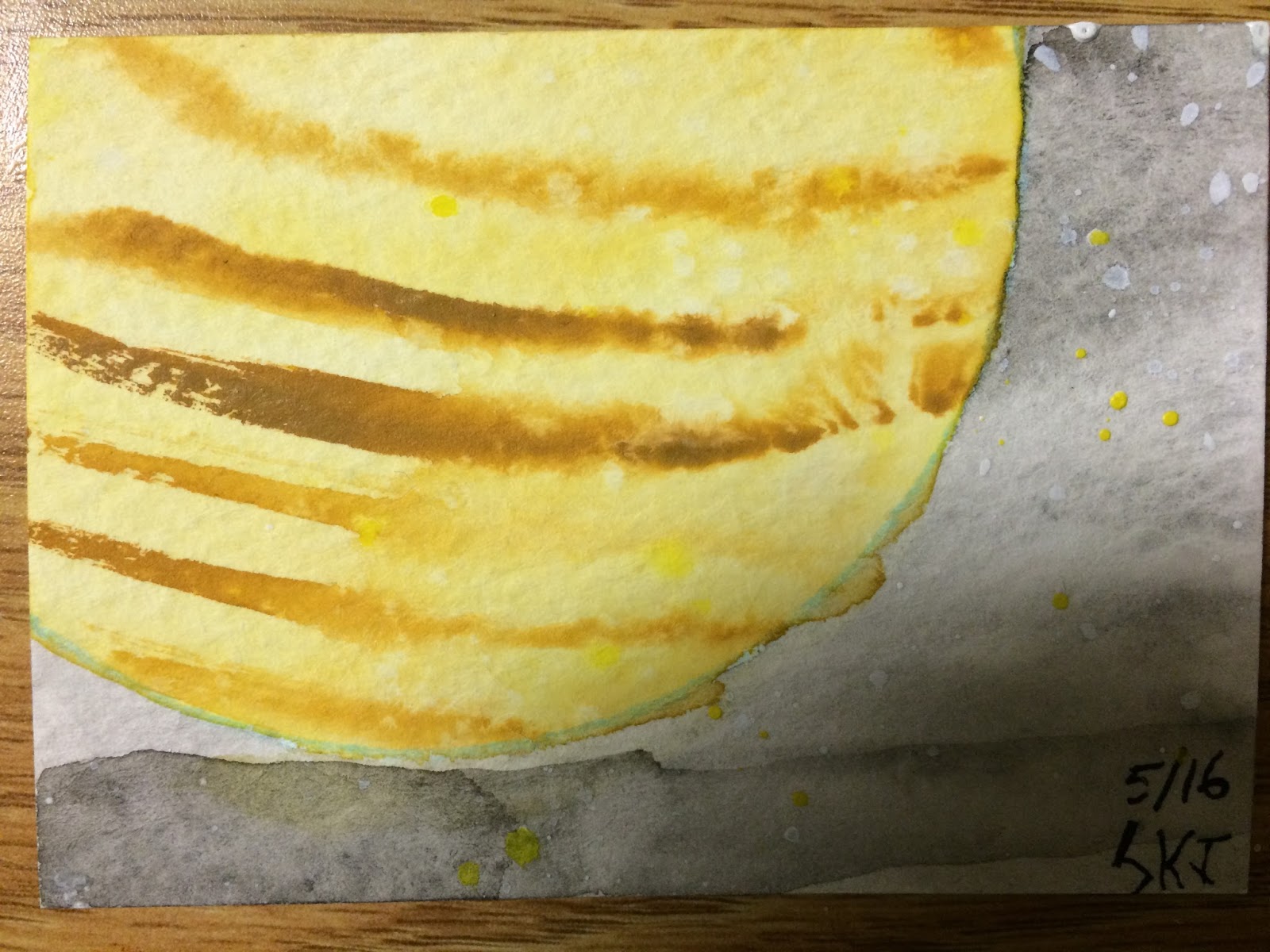
I've been painting a lot recently, mostly space because it's easy and doesn't need to exactly match up to something real. The stars have made a complete mess of my desk.

Room Draw was last week; I will be living in the dorm that's generally considered the worst dorm on campus, but I know a few people living on my floor, so that's good, and I'm also not on the far side of the lake from everything else, which was a possibility. I'm going to be so lost at the beginning of next year when I don't know where all my friends live anymore.

I finished reading Purity by Jonathan Franzen recently. It was a really interesting book. It was cool to see the stories of all the separate characters begin to intertwine and entangle. Strangely, I feel like every mother-child relationship in the book was definitely odd.

I've started reading Circling the Sun by Paula McLain. It's about Beryl Markham, so I suppose that makes it a form of historical fiction. I'm really enjoying it, although I'm not very far along yet.

Recently I re-watched Ant-Man, and I think I enjoyed it a lot more the second time. The first time I watched it was probably 3am in the morning and I'd been awake for 20 hours or so, which, for me, is unusual, and I was really annoyed by how Hope wasn't allowed to do anything and this random thief just becomes a super-hero for them over the course of a few weeks. I think the second time I watched it and was a little more awake, I was able to get how this conflict was an actual part of the movie that made sense within the movie, and enjoyed it more. I feel like Ant-Man worked well in part because it wasn't just a superhero movie; it was a bit more of a heist movie, that happened to have a setting full of superheroes and cool powers.

Saturday, May 14, 2016

Captain America: Civil War

I recently read Creation of Patriarchy by Gerda Lerner. It's something I've been meaning to read for a while, and it was interesting to read about some history and ideas of how we got to where we are today. It was a little shocking to read about how things were for women in the past--it's something I knew, but not something I've spent time thinking about consciously lately. The more disturbing thing is that there are still many parts of the world today where women are considered the property of their husbands, fathers, or brothers, denied access to education, or suffer other inequalities.

I'm also almost finished reading Deep South by Paul Theroux. I received the book as part of a book club, but I'm really not enjoying it at all. Maybe I just don't need to be reading travel books, but, in my opinion, the author manages to come off as condescending and full of himself and a bit rude most of the time, which is really making it difficult for me to enjoy the book.

All my friends are already done with classes and exams. Meanwhile, I still have a bit more than three weeks remaining before I'm done with exams. It's very strange to be the last one out of school, but it's also not warm enough here for me to feel like it's actually summer.

I re-watched Captain America: Winter Soldier this week with a friend in preparation for Captain America: Civil War last night. I'd forgotten a lot since I last watched that movie. I really liked that Natasha and Steve's friendship was platonic--it was refreshing to see something different for a change. It was also a reminder of how confusing all the stuff going on in the Marvel Cinematic Universe can get if you're not paying close attention.

Civil War was fantastic! I really enjoyed it. At this point, I'm not certain if we're capable of not enjoying Marvel; they've set themselves up with enough a good track record that we're far more willing to be forgiving to any mistakes they might make. Spoilers ahead.

What did really bother me was that I felt there was a missing sense of closure at the end. Steve sends Tony the letter which suggests that they're all still going to work together, but it hasn't really addressed what's going to happen with the Sokovia Accords or any of the issues that caused the team to fracture in the first place. T'Challa is the only person who has learned anything from the entire ordeal, when he decides to forgo vengeance. It seems like Steve and Tony haven't learned anything, they've just decided to quit trying to kill each other. Nonetheless, I still enjoyed the movie.


Tuesday, May 3, 2016

The Original Affluent Society


From looking at some of my Friday Flowers this term

Maybe these wrinkles are the reason I've had painting difficulties
This trimester, I'm taking Introduction to Anthropology, Indo-European Folktales, and French 103. I'm really enjoying all my classes; my professors are good. I've been painting more, since more of my brushes and watercolor paints are up here for the spring term. I'm pretty pleased with some of my efforts, if I do say so myself. I haven't been as happy with some of the stuff I've tried to do on larger paper--maybe that has something to do with how rippled the paper has become...I should probably try to use up this block before it gets any older and sadder.

I learned something interesting in Anthropology today. We've been reading The Dobe Ju/'hoansi by Richard Lee for one of our class readings. It's about Richard Lee's ethnographic work with a group of people in the Kalahari desert in Africa. Along with his ethnographic work, he also collected scientific data about number of calories, types of foods consumed, and hours worked. Interestingly, he found that only about 20 hours per week were spent on getting food. When he added in housework, tool repair, and other types of work, (work that we in Western society would not count as part of a traditional 40hr work-week job), that number came to about 42 hours of work per week. Calorically, the Ju/'hoan diet was appropriately meeting their needs for nutrition and diversity. This was a bit strange to me, because it's the opposite of what most people probably expect. Marshall Sahlins also wrote an essay further exploring the topic of the hunter-gatherer society's work week. I'm not really sure what it means, but it was still interesting.
Can you guess this landmark?

Thursday, November 12, 2015

Looking Towards Winter Term

I registered for my classes Tuesday night. I'm pretty excited I get to finally take some biology again, although I'm worried this may be a more chemistry-heavy part of biology, which has never been my favorite. (Also the labs are four hours long; that's a really long time!) I also registered for the second term of French with my same professor. My third class is Literature of the American South, which is a Writing Rich course; it should be interesting reading and discussion, but I hope the writing part doesn't murder me. All of the new professors seem to have a good track record based on other students' experiences.
I'll be working in Mail Services next term instead of the Post Office. There is a possibility that the two may be combined once we get to Spring Term. For now, though, I've heard that Mail Services is a good opportunity to work on homework. I may need it; I'll have a Writing Rich course and a lab course in the same term.
We still haven't seen any legitimate snow yet, but they are already beginning to setup the ice skating rinks on The Bald Spot. We probably won't see those actually functional until Winter Term.
Now I just have to make it through the rest of ninth week and tenth week, and then I get to go home for Winter Break (and SeaBase)!